

Catholic Art and Jewelry
New! St. Brigid of Kildare – Holy Card – pack of 10/100/1000 - by Sue Kouma Johnson #173
New! St. Brigid of Kildare – Holy Card – pack of 10/100/1000 - by Sue Kouma Johnson #173
Couldn't load pickup availability
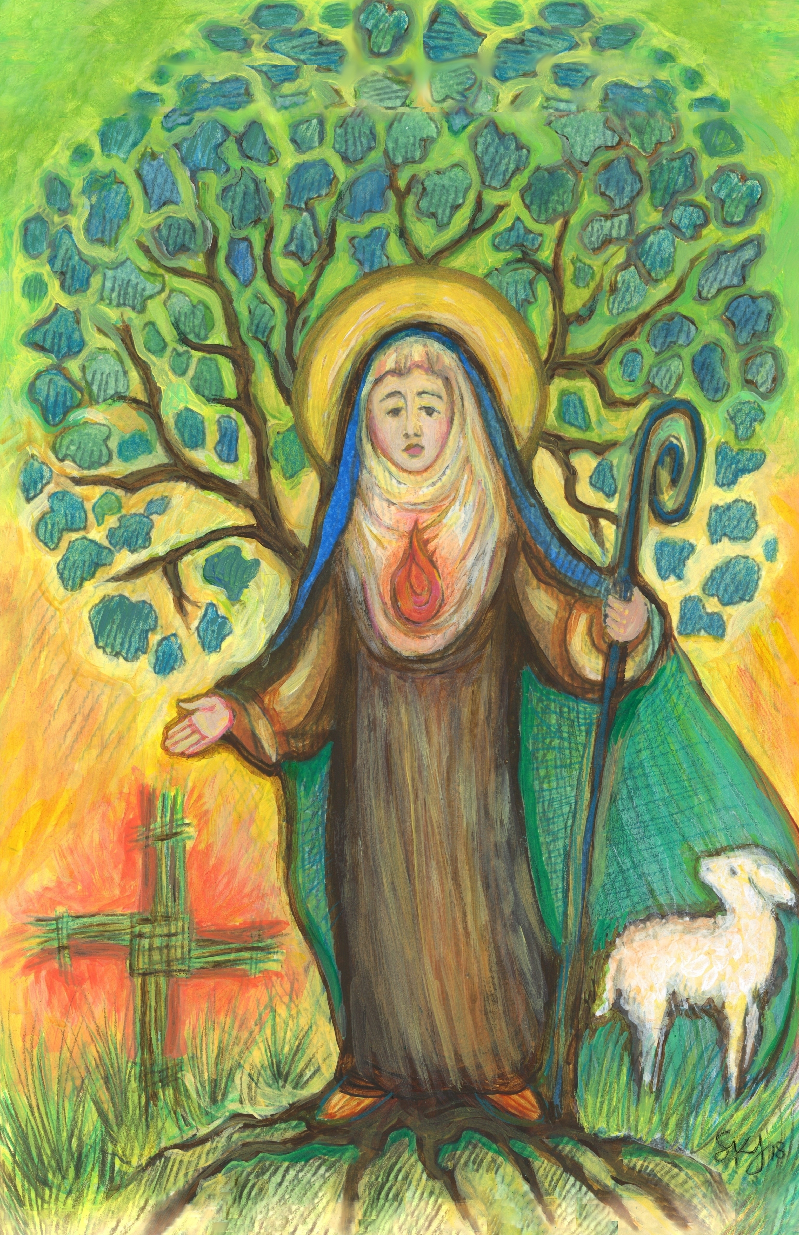
Sue’s colorful card is of St. Brigid of Ireland, the patroness of Ireland. She is also known as St. Bride or St. Bridget. We have a prayer on the back to St. Brigid made by an Irish Cardinal who lived in Australia.
The original was painted in colored pencil and acrylic paint on paper by Sue Kouma Johnson.
Saint Brigid was born Brigit, and shares a name with a Celtic goddess from whom many legends and folk customs are associated.
It is widely believed that Brigid's mother was Brocca, a Christian baptized by Saint Patrick, and her father was Dubthach, a Leinster chieftain. Brocca was a slave, therefore Brigid was born into slavery.
Many stories of Brigid's purity followed her childhood. She was unable to keep from feeding the poor and healing them.
Eventually, her father tired of her charitable nature and took her to the king of Leinster, hoping to sell her. As he spoke to the king, Brigid gave his jeweled sword to a beggar so he could barter it for food for his family. When the king, who was a Christian, saw this, he recognized her heart and convinced Dubthach to grant her freedom by saying, "Her merit before God is greater than ours."
It is said that when Saint Patrick heard her final vows, he accidentally used the form for ordaining priests. When someone pointed out his mistake, he replied, "So be it, my son, she is destined for great things." Thus, she is shown with the Shepherd's Crook of a bishop.
Little is known about Saint Brigid's life after she entered religion. We do know she founded a monastery in Kildare. It was built above a pagan shrine to the Celtic goddess Brigid, which was beneath a large oak tree. Triumph of the Church over paganism!
Brigid and seven friends organized communal consecrated religious life for women in Ireland and she founded two monastic institutions, one for men and one for women. Brigid invited a hermit called Conleth to help her in Kildare as a spiritual pastor.
Her biographer reported that Brigid chose Saint Conleth "to govern the church along with herself."
She later founded a school of art that included metalwork and illumination, which Conleth led as well. It was at this school that the Book of Kildare, which the Gerald of Wales praised as "the work of angelic, and not human skill," was beautifully illuminated, but was lost three centuries ago.
The cross in the picture represents a practice Brigid had of weaving crosses out of reeds, and teaching children how to do it.
The Trias Thaumaturga claims, "Between St. Patrick and Brigid, the pillars of the Irish people, there was so great a friendship of charity that they had but one heart and one mind. Through him and through her Christ performed many great works."
On February 1 525, she passed away of natural causes. Her body was initially kept to the right of the high altar of Kildare Cathedral, with a tomb "adorned with gems and precious stones and crowns of gold and silver," but in 878, during the Scandinavian raids, her relics were moved to the tomb of Patrick and Columba.
Her feast day is celebrated on February 1st,and she is the patron saint of Ireland, dairymaids, cattle, midwives, Irish nuns, and newborn babies. (from Catholic Online)
2.75x4.25 inches
Sturdy 14 point cardstock.
Matte finish to help keep fingerprints off.
Crystal clear plastic sleeves available.
Thank you for your interest.
Sue and John Johnson
St. Mary's Parish, Lincoln, Nebraska
"In order to communicate the message entrusted to her by Christ, the Church needs art." St. Pope John Paull II, in his "Letter to Artists," 1999.
Image Restoration and Card © www.CatholicArtAndJewelry.com